The Assassin
To cap their most prolific year to date (42 films in 1967), Shaw Brothers turned to the men most responsible for the studios swelling coffers, director Chang Cheh and actor Jimmy Wang Yu. 5 months earlier, their film The One-Armed Swordsman started Chang’s streak of million-dollar box-office smashes. In his follow-up, Chang laid bare the force driving the studio’s growth–the Japanese film industry.
Run Run Shaw admired, and mirrored, Japanese studios, molding much of Shaw Brothers to follow their example. It was in 1967 that this emulation really began to payoff. Shaw’s two imported Japanese directors, Inoue Umetsugu and Kō Nakahira, made their first films for Shaw Brothers in 1967, and the studio’s biggest hit of the year, The One-Armed Swordsman was a direct descendant of Japan’s most popular handicapped swordsman, Zatoichi.
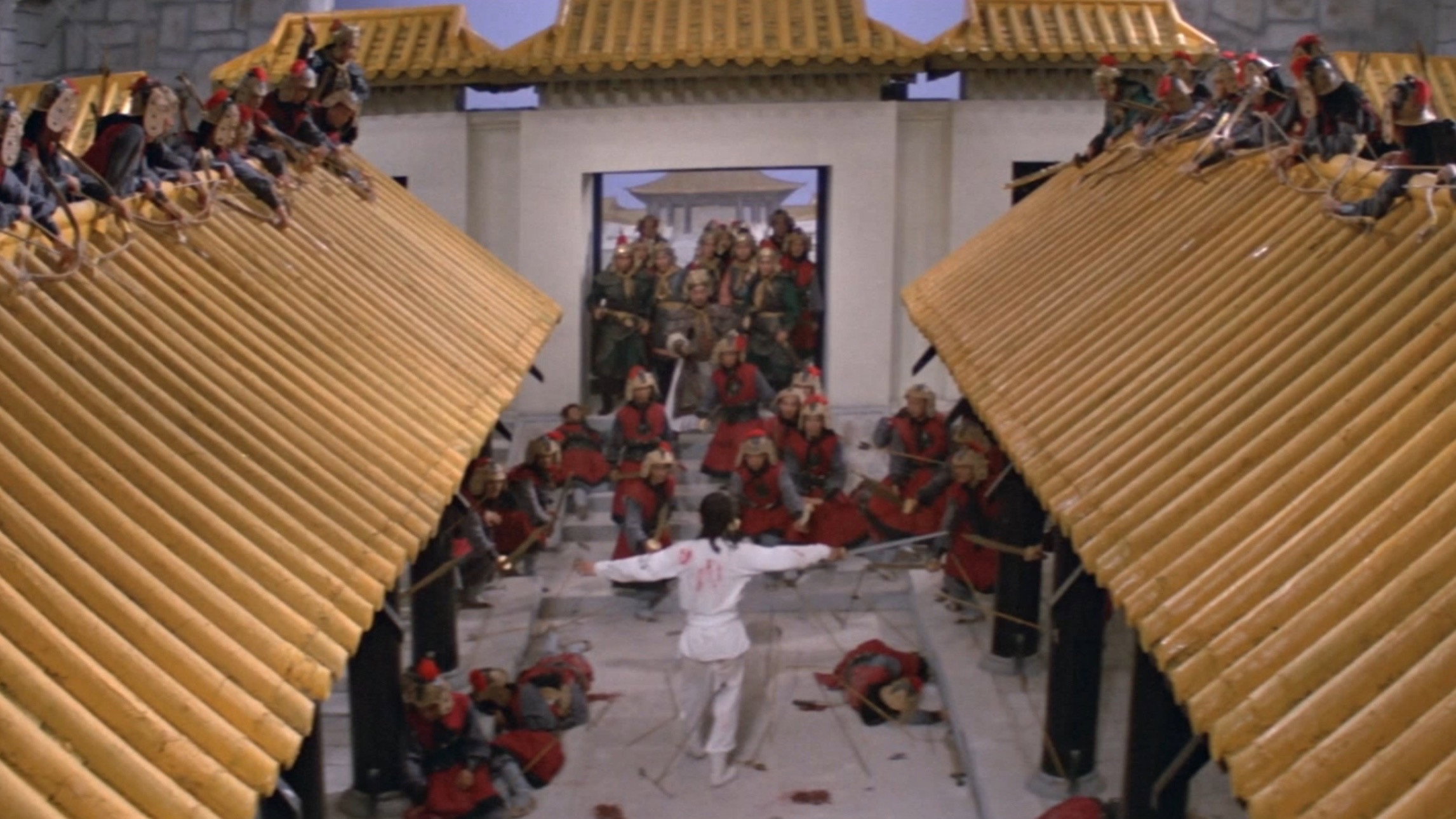
In The Assassin, director Chang continued the Japanification of Shaw Brothers studio, taking the most Chinese story he could find (an ancient tale of a political assassin and his devoted sister) and making every effort to make it appear Japanese.
Over the film’s introduction, which explains the political turmoil of the “Warring States” period, Japanese music plays[1]. And as hero Nie Zheng (Jimmy Wang Yu) moves from his quiet, modest home up through the houses of power, the sets continually mimic those seen in Japanese samurai films.
These Japanese sets provide the background for the very Chinese story of Nie Zheng, a hot-headed youth who wants, like all hot-headed youth, to make his mark in history. But when fate, in the form of ex-minister Yen Chung-Tzu (Tien Feng), comes calling, Nie honorably puts history on the back burner until he finishes providing for his mother and sister (Li Hsiang-chun), who later repays her brother’s filial piety.
Cheng later dismissed the Japanese stylistics of The Assassin as artistic posturing, and most current writing about The Assassin details the film’s allegories of Hong Kong’s 1967 riots and China’s growing Cultural Revolution[2]. But from my modern perspective, the film’s allegories don’t look that different from all of Chang’s other films that feature frustrated youth who make their names through bonded friendships, bountiful slaughter and beautiful suicide. For me, it’s the film’s aesthetics that make it unique.
fn1. I’m making some educated guesses about the music in The Assassin. Like some of the other Celestial DVD releases, most of the film’s original music and sound effects have been replaced with hideous, ill-conceived crap. These changes make the film nearly unwatchable. However, the Japanese music over the credits sounds original.
fn2. I might be making up Chang’s dismissal of this film. I don’t currently have access to my copy of Chang Cheh’s autobiography. Once I can get my hands on it, I’ll confirm this statement.
Ian Whitney
Published: 2005-05-16