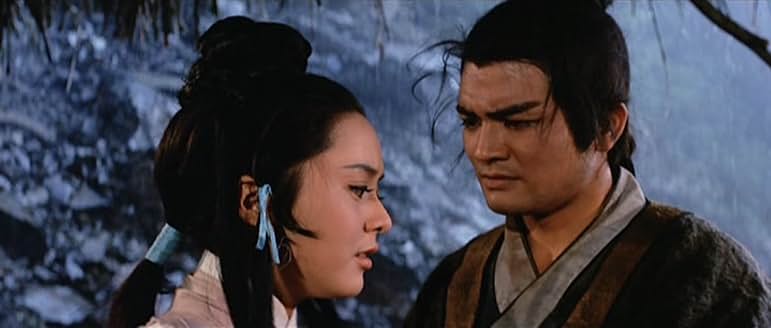
Swordsman at Large
Hsu Tseng-Hung was always attracted to the more literary side of wuxia. Though responsible for helping start Shaw Brothers’ “New Wuxia Era” in 1965, the films he made never seemed part of the movement. The plots usually focused on interpersonal dynamics rather than martial action. The fights, when they happened, were stagey and deliberate. The camera work was usually efficient and plain, thanks to Hsu’s Japanese training in how to shoot quickly and cheaply.
If Chang Cheh’s manly brawlfests became the stereotype of Hong Kong wuxia and King Hu’s painterly ruminations achieved the same for Taiwan, then Hsu’s was very clearly more in the Taiwanese camp. Though he never seemed to show much inclination for Hu’s beautiful framing or graceful camera moves. Which makes Swordsman at Large feel like both a perfect fit and a total surprise.
Filming in Taiwan with a Taiwanese supporting cast, Hsu seems to have taken his time with this one. There’s some beautiful imagery – a scene shot inside a hollowed out tree is a particular standout – and some lovely camera movement. I don’t know the change is due to working out of the studio, or he was inspired by Taiwan’s beauty, or if it was the influence of Taiwanese art director Chen Hsiao-Kuei. Regardless, it’s a welcome change.
It would also be the last of his films released by Shaw Brothers. Though I don’t think it was the last film he made for the studio. This was clearly filmed well before 1971 (the appearances of Sammo Hung, Chen Hung-Lieh, and Chang Yi are giveaways). And I don’t know that production went smoothly, as HKMDB points out that two different actors played the main villain, suggesting maybe a delayed production.
It took Shaw Brothers long enough to release this that by the time it came out Hsu had already made two films for Golden Harvest and left that studio.
The delayed release of this movie means that Swordsman at Large could be Gu Long’s first work with Shaw brothers. He provided the script, which he later turned into the novel Xiao Shiyilang.
That novel has since been adapted at least eight more times, for both film and television in Hong Kong, Taiwan and China. It’s an enduringly popular work. And though Swordsman at Large doesn’t contain all of the story that would later end up in the novel, it’s easy to see the appeal. A rakish hero who lives by his own rules, a brash female knight who craves power, a beautiful swordswoman who comes to see the goodness in the rakish hero, and the upright good guy who loves a woman who doesn’t love him back. Combine all that with the usual wuxia tropes of super powerful swords and martial arts intrigue and you’ve got a solid time.
Hsu, being Hsu, really leans in to the interpersonal dynamics. There’s far more shots of a crying Margaret Hsing Hui in the movie than there are of dude swinging swords. Which I’m fine with, both because Margaret Hsing Hui is good in one of her few wuxia roles and because Hsu’s fight staging is, as per usual, pretty basic. Though there are a few fun moments mixed in, thanks to a villain who can punch out a person’s heart.
Ian Whitney
Published: 2026-08-11