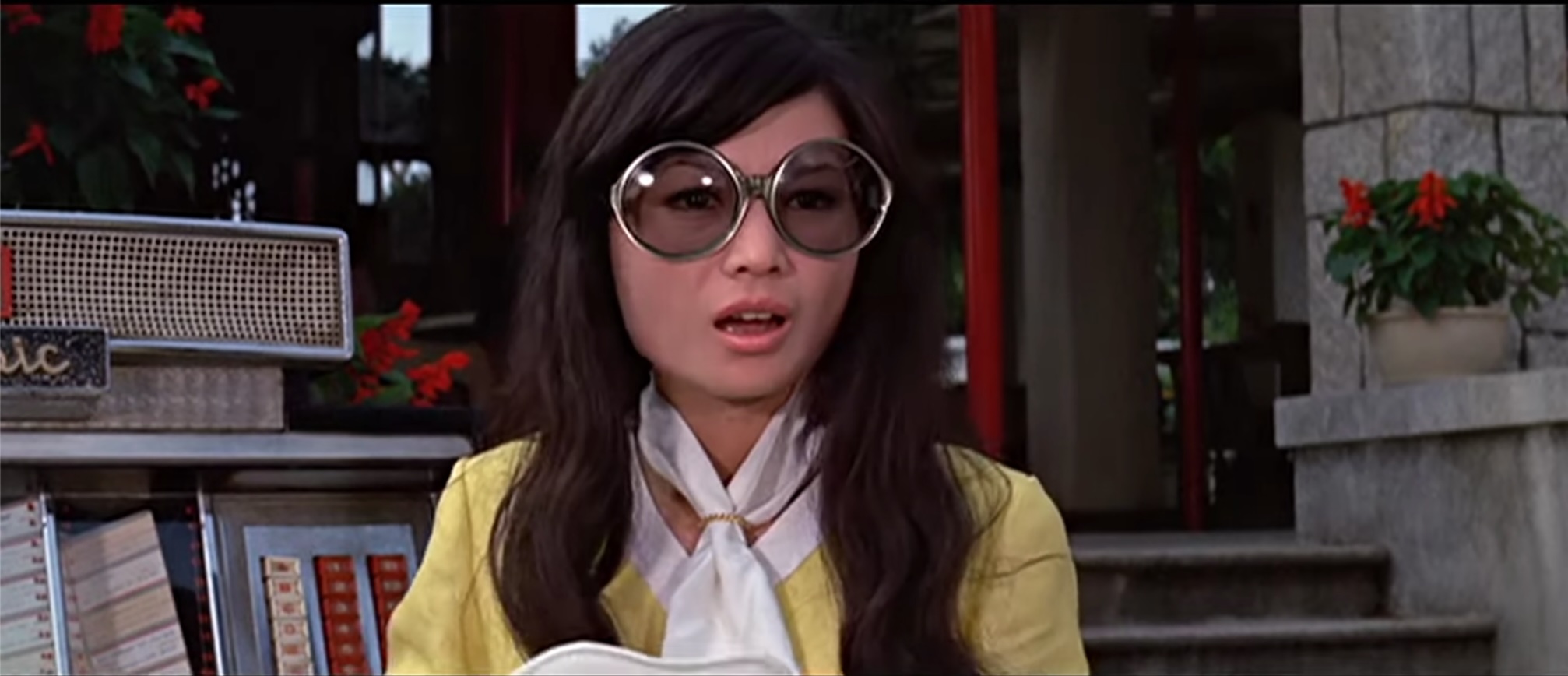
Sunset
Similar to previous entries in Shaw’s “tragic love” genre like A Place to Call Home and The Younger Generation it’s tempting to read the confusing mishmash of tones in Sunset as commentary, as if we’re supposed to draw some sort of deeper meaning from the whiplash between scenes of frothy youth romance and tragic death.
While I think that reading is valid for something like The Younger Generation, I think Sunset might just be a confusing mishmash of tones. As I mentioned in my review of Long Road to Freedom, director Inoue Umetsugu had a definite style. “His films were usually poppy, colorful, and focused on women and fashion.” To say that he could not do dark movies is to undersell his talent. But by this point in his career I’m not sure how much effort he wanted to put into these Shaw Brothers films.
For the past two or three years Shaw Brothers had let Inoue make his films in Japan and work with multi-national casts to make fizzy youth movies that the studio could sell in Hong Kong, South Korea and many other markets. Initially these films did OK financially as far as I can tell, but I’m guessing that the returns were starting to diminish.fn1
In 1971 something changed. I don’t know exactly what, but I do know that Inoue returned to Hong Kong to make two films back-to-back and that these films would be his last for Shaw Brothers. The exact business details are unclear. Did Inoue want to stop? Did Shaw fire him but demand two more pictures to satisfy his contract? Did the studio try a new approach thinking that would improve box office, but dropped it once those returns didn’t materialize? I don’t know.
Regardless, I don’t think Inoue was giving this movie his full attention. In one scene a fashion model in the background clearly trips and nearly falls on her face, yet that was the footage they went with. If he’s not noticing things like that then I don’t think Inoue was deeply invested in trying to delicately balance the tones of a film that starts with a goofy meet cute and some musical numbers and that ends with tragedy and sadness.
He certainly wasn’t helped by the casting of Paul Chun Pui, who is an actor I like but here struggles to sell his character of an emotionally damaged rich kid who pretends to be an orphan because he’s mad at his parents. Oh, and he also has to sing a bunch of songs and act like a goof.
Similar to some of Inoue’s other films for Shaws this was a remake of one of his earlier films, titled (roughly) Lover in the Sunset. I’d love to compare the two, but this one appears to be totally unavailable. It might have been on jp-films, but that site has disappeared (unsurprisingly, as it was 100% illegal). From what I can find the original also featured musical numbers and helped make singer/actor Kensaku Morita a bit of a star. It’s possible the studio thought they could do the same for Paul Chun Pui here.
fn1: It’s impossible to get a full picture of how much money these movies made. I don’t have a any source for South Korean or Taiwanese box office at this time. And the Hong Kong numbers are full of holes. But based on the data I do have in 1969 Inoue’s biggest box office success came in around number 9 on the Hong Kong chart, and in 1971 that had dropped to 29th.
Ian Whitney
Published: 2026-08-23